
Luke Thompson
Learning Manifold and Itô Dynamics with Branched Neural Rough Differential Equations
Abstract
Neural rough differential equations (NRDEs) stay accurate under irregular sampling while taking far fewer integration steps than standard neural differential equations. They summarise a finely sampled driver by its log-signature and advance the hidden state over coarse intervals using the log-ODE method. But this efficiency rests on the shuffle algebra, the algebraic counterpart of Stratonovich calculus, so NRDEs cannot expose the quadratic-variation terms Itô dynamics require, nor the ordered covariant derivatives governing Itô flows on connection-equipped manifolds. We introduce Branched Neural Rough Differential Equations (B-NRDEs), which recast the log-ODE step as geometric numerical integration on the state-space manifold, matching the driving algebra to the governing calculus: Grossman–Larson rooted trees for Euclidean Itô dynamics, Munthe–Kaas–Wright planar trees for ordered covariant derivatives on manifolds, and the shuffle algebra in the Stratonovich case. A branched signature-kernel objective then makes quadratic variation visible during training, enabling Itô-consistent law matching. We demonstrate B-NRDEs on rough Bergomi volatility, sim-to-real SO(3) forecasting, and SPD covariance dynamics.
Our speaker
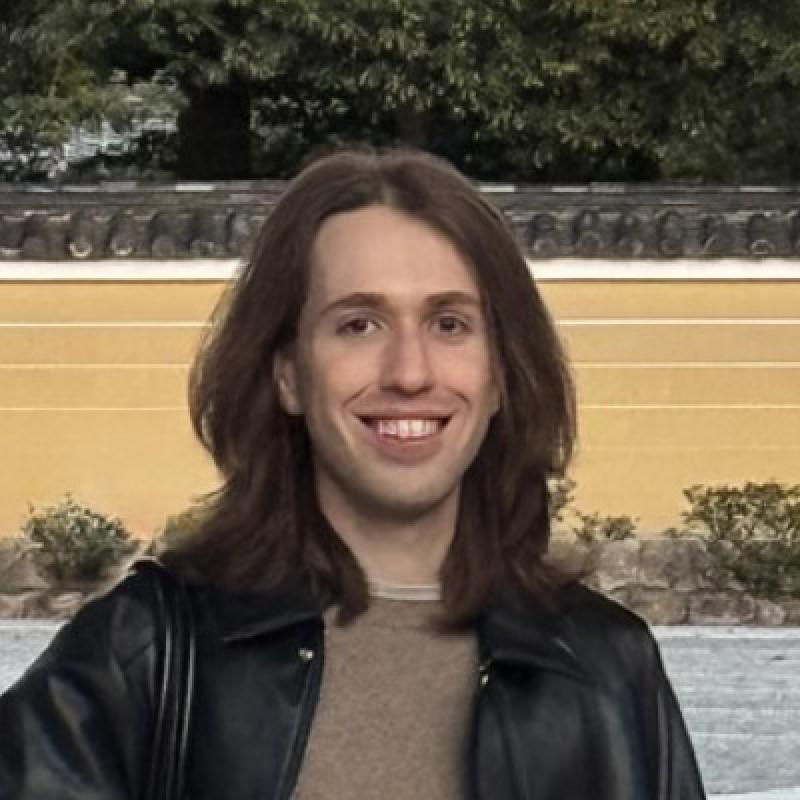
Luke Thompson is a PhD student at the University of Sydney working on machine learning applications of rough paths in non-Euclidean settings such as Lie groups and homogeneous spaces. His recent work develops branched neural rough differential equations for learning manifold and Itô dynamics, along with structure-preserving schemes for neural SDEs on Lie groups. More broadly, he is interested in geometric approaches to deep learning, with work appearing at venues including ICML and ICLR.
To become a member of the Rough Path Interest Group, register here for free.

